

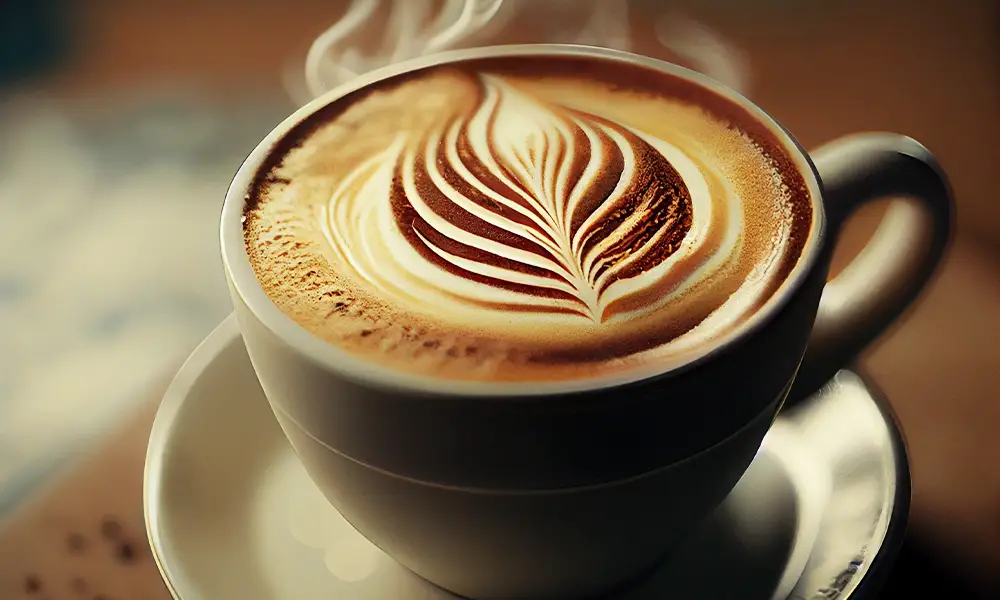
A bone dry cappuccino is espresso topped with milk foam only, with no liquid steamed milk. The barista steams the milk as usual, then holds back the liquid part and spoons just the foam over the shot. You get a lighter cup that tastes more strongly of espresso, with less milk than a regular cappuccino. “Bone dry” is the far end of the wet-to-dry scale baristas use to describe how much foam versus liquid milk goes into a cappuccino.
Wet vs Dry vs Bone Dry Cappuccino
A regular cappuccino is a small drink, usually 5 to 6 oz, made with espresso, steamed milk and a thick layer of foam in roughly equal parts. Asking for it “wet” or “dry” changes the balance between the liquid milk and the foam. The espresso stays the same.
| Order | Steamed milk | Foam | How it tastes |
|---|---|---|---|
| Wet | More | Thin layer | Milky and sweet, close to a small latte |
| Regular | About a third | About a third | Balanced espresso and milk |
| Dry | A little | Most of the cup | Lighter, more espresso flavor |
| Extra dry | Just a splash | Almost all | Close to bone dry |
| Bone dry | None | All of it | Strongest espresso flavor, airy texture |
These terms are not standardized. One café’s “extra dry” can be another’s “bone dry”, so say what you want if it matters.
Go wet enough and you are close to a latte; go dry and the drink becomes mostly espresso and air. The terms are most common in the United States, especially at chains such as Starbucks, where “bone dry” is a standard way to customize a cappuccino.
What Does a Bone Dry Cappuccino Taste Like?
- More espresso, less milk. With no liquid milk to dilute it, the coffee comes through more strongly, and there is less of the natural sweetness that steamed milk adds.
- Airy texture. You drink the espresso through a thick, light cap of foam rather than a creamy, milky body.
- A light cup. Foam is mostly air, so a bone dry cappuccino feels surprisingly light when you pick it up. That is normal, not a short pour.
- Stays hot longer. The thick foam cap helps hold in the heat of the espresso underneath.
- Same caffeine. Caffeine comes from the espresso, not the milk, so a bone dry cappuccino with a double shot has the same caffeine as a regular one, about 128 mg.
- Less milk. It uses less milk than a regular cappuccino, so it also has fewer calories.
How to Order One
Just ask for a “bone dry cappuccino.” If you want a little milk under the foam, ask for a “dry” or “extra dry” cappuccino instead. Two things to expect: the cup will feel light, and there will be no latte art, because stiff, dry foam does not pour into a design. A good barista will make it without blinking; it is one of the most common cappuccino requests.
How to Make a Bone Dry Cappuccino at Home
Bone dry cappuccino
You need an espresso machine with a steam wand, a small milk pitcher, cold milk and a 6 oz (180 ml) cup.
- Pull a double shot into the cup: 18 g of coffee to about 36 g of espresso in 25 to 30 seconds.
- Pour about 4 oz (120 ml) of cold milk into the pitcher. It will roughly double in volume.
- Stretch the milk longer than usual. Keep the steam tip just under the surface so it keeps drawing in air with a steady hiss, until the milk has about doubled.
- Stop at 140 to 155°F (60 to 68°C), about when the pitcher becomes too hot to hold.
- Let it rest 20 to 30 seconds so the foam separates from the liquid milk.
- Hold back the liquid with a spoon and spoon the foam over the espresso until the cup is full. Serve right away.
Which milk? Skim and low-fat milk make stiffer, drier foam that holds its shape well, which suits this drink. Whole milk makes richer, creamier foam that is a little softer. For non-dairy, barista-style oat milk foams best. Our guide to the best milks for coffee covers the options.
No steam wand? Heat the milk, then foam it with a handheld frother or by pumping it in a French press. Both make the stiff foam a bone dry cappuccino needs. See how to froth milk for each method. The leftover liquid milk can go into a second drink.
Bone Dry Cappuccino vs Macchiato and Cortado
These three are easy to mix up because all of them are small and espresso-forward.
- Bone dry cappuccino: espresso with a full cup of foam on top and no liquid milk.
- Macchiato: espresso “marked” with just a spoonful of foam, served in a small espresso cup.
- Cortado: espresso with about the same amount of steamed milk and very little foam, so it is smooth rather than airy.
For more on the shot at the heart of all of these, see our guide to espresso, or browse the full list of coffee drinks.
Former roastery owner and coffee tour operator. Steve spent five years roasting coffee for his own shop and wholesale customers. More about Steve